Ways that the home can be adjusted to support autistic children and adults who are hyper-sensitive to smell.
7 January 2025
BY NEUROKIND DESIGN
Those who are hyper-sensitive to olfactory (smell) stimuli are often dysregulated by strong or lingering odours. Smell sensitivities can vary greatly between individuals; what one person seeks out may be triggering to another. This is because the way we as humans process smell and distinguish between pleasant and unpleasant smells is often deeply connected to our individual memories and lived experience. Our sense of smell is also one of the most sensitive and reactive of all of our senses [i]. According to a 2014 research study, humans are able to discriminate between over a trillion different scents! [ii]
If you are hyper-sensitive to smell, you may:
•Avoid certain smells.
•Avoid places or foods based on their smell.
•Become easily distracted or dysregulated by certain smells.
•React more strongly to smell than others or be able to smell things that others may not notice.
•Be averse to perfumes/colognes.
The Research
As far as we are aware, there is currently little to no direct research on how adjusting olfactory stimuli in interior environments impacts those with autism. However, sensitivity to olfactory stimuli appears to be a common trait in autistic individuals as well as for those living with other sensory processing differences. Research studies surrounding autistic people and their perception of odours highlight differences in olfactory processing compared to neurotypical people [iii, iv]. A 2020 study found that the autistic participants differed in their ability to detect odour compared to the neurotypical control group. In particular, the autistic participants that were assessed to be hyper-sensitive to smell were found to have a higher threshold for odour detection than their neurotypical and hyposensitive counterparts [v].
Acknowledging that a higher threshold for detecting smell does exist in those with autism, it could be reasoned that reducing and managing odours in the home environment may help those who are hyper-sensitive to smell feel more regulated, particularly if odours are found to be distracting or overwhelming.
Below, we suggest simple ways that you adapt your home environment to support hyper-sensitivity to scents, and provide some examples of odourless and smell-reducing products. [1]
1. Choose odourless or low-odour products and materials
Identify any smells in the home that you find overwhelming and make a plan to eliminate or contain them, or perhaps replace them with odourless or low odour products where possible. This could be things such as cleaning chemicals, detergents, fragrances or lingering food smells, for example.
If possible, store cleaning products, paints and other household chemicals in a well ventilated area outside of the home, such as a garage, shed or storeroom. If this is not possible, keep them in a closed cupboard. As always, make sure to store them safely and always follow the storage instructions given.
When building or renovating, consider the odours and emissions of the materials and products used. For example, if the smell of traditional paint is something you are sensitive to, consider a low-emissions paint like Dulux Ultra-Air, or Bauwerk limewash paints which are claimed to be low-odour.
2. Consider ventilation and air quality
Air quality can be a significant contributor to smells in our indoor environments and can be affected by many factors, such as ventilation quality, pollutants, mould, dust, smoke and volatile organic compounds (VOCs). Addressing air quality in your home in the following ways may help remove unpleasant smells:
•Ensure that exhaust fans are installed in bathrooms and wet areas to extract any damp or unpleasant odours. Ideally bathrooms should also have an operable window to the outside to allow for fresh air flow and to further prevent the build-up of mould and moisture.
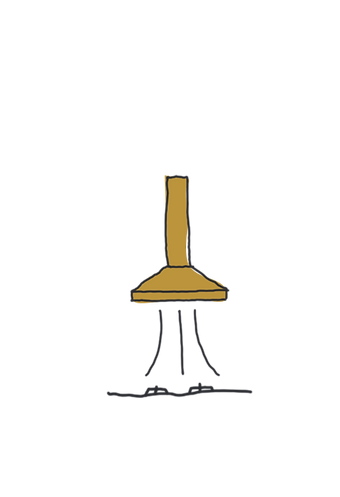
•Make sure that your kitchen has an appropriate extraction fan over the stove to extract food smells.
•Open doors and windows to let fresh air into the home. On the flip side, if unpleasant, uncontrollable smells from outside the home are an issue, ensure doors and windows have good seals and consider using filtered air instead.
•Consider using an air purifier, or a dehumidifier in humid conditions.
•Ensure that the air-conditioning filters and air ducts in your home are cleaned regularly.
•Clean carpets, rugs, bedding and other textiles regularly to prevent the build-up of dust and odour causing bacteria.

An example of an air purifier.
Image credit: IKEA
Install appropriate extraction/exhaust fans in cooking and wet areas
Open the doors and windows

3. Incorporate smells that you find pleasant
Being highly sensitive to scent can also mean that you respond more intensely to smells you find pleasant. You can incorporate your favourite smells into your home to help you feel more grounded, as long as they don’t become distracting or overwhelming. They can also be used to counteract or mask any dysregulating smells where they can't be eliminated.
Some of the things you could incorporate include; essential oils, aromatherapy, fragrant plants, incense or scented candles.


If you’d like to learn more about how to reduce odour within your home, get in touch with us today. We’d like to hear from you!
Endnote:
[1] We recognise that environments are rarely occupied by one, and some of the strategies we suggest may not address opposing needs. However they are intended to inform, empower and create conversations about how neurodivergence can be supported and celebrated in our physical environments. In the case of differing sensory needs in environments occupied by multiple people, we recommend prioritising adaptability, control and flexibility as much as possible.
References:
[i] NHS. n.d. "Olfactory." NHS Essex Partnership University. Accessed December 19, 2024. https://eput.nhs.uk/patient-carer-and-visitor/children-and-young-people-experiencing-sensory-processing-needs/explore-our-senses/olfactory/
[ii] Bushdid, C., Magnasco, M. O., Vosshall, L. B. & Keller, A. 2014. “Humans Can Discriminate More than 1 Trillion Olfactory Stimuli.” Science, 343 (6177): 1370-1372. https://www.science.org/doi/10.1126/science.1249168
[iii] Ashwin, Chris, Emma Chapman, Jessica Howells, Danielle Rhydderch, Ian Walker and Simon Baron-Cohen. 2014. “Enhanced olfactory sensitivity in autism spectrum conditions” Molecular Autism 5 (53): 1-9. https://doi.org/10.1186/2040-2392-5-53
[iv] Sweigert, Julia, Tanya St. John, Kristin Kawena Begay, Greg Davis, Jeffrey Munson, Eric Shankland, Annette Estes, Stephen Dager, and Natalia Kleinhans. 2020. “Characterizing Olfactory Function in Children with Autism Spectrum Disorder and Children with Sensory Processing Dysfunction.” Brain Sciences,10(6): 362. https://doi.org/10.1186/2040-2392-5-53
[v] Mingdi Xu, Yasuyo Minagawa, Hirokazu Kumazaki, Ken-ichi Okada, and Nozomi Naoi. 2020. “Prefrontal Responses to Odors in Individuals With Autism Spectrum Disorders: Functional NIRS Measurement Combined With a Fragrance Pulse Ejection System.” Frontiers in Human Neuroscience, 14 (523456): 1-17. https://pmc.ncbi.nlm.nih.gov/articles/PMC7579723/pdf/fnhum-14-523456.pdf
Disclaimer:
The product suggestions provided on this blog are intended for general informational purposes only. Neurokind Design Research and Knowledge do not endorse or guarantee the products suggested by us. We do not receive compensation or incentives in exchange for a recommendation.
Neurokind Design Research and Knowledge cannot guarantee that all information is accurate, complete, or up-to-date. Any reliance you place on such information is strictly at your own risk. We encourage readers to conduct their own research and make decisions based on their unique circumstances.
The information, ideas, advice and suggestions presented in this blog are not substitute for professional advice, treatment or assessment. The author shall not be liable or responsible for any loss, injury, disruption or damage allegedly arising from any information or suggestion in this blog.